

CHARLEROI, Pa. — Nationally, the 2026 midterms were a blue tsunami — so much so that the effects could be felt even in deeply red Southwest Pennsylvania, where Democratic Gov. Josh Shapiro and Democratic Rep. Chris Deluzio improved their electoral performances and Republican Rep. Guy Reschenthaler saw his share of the vote shrink, even as he won.
“The Democratic performances were just better than we’ve seen in a long time,” said Mike Butler, a Democratic strategist in Southwestern Pennsylvania. “I thought it was going to be a better year for Democrats than typical, but not this good.”
This marks the ninth consecutive election cycle I’ve written an election post-mortem for PoliticsPA based on my reporting in six Southwest Pennsylvania counties: Allegheny, Beaver, Fayette, Greene, Washington and Westmoreland.
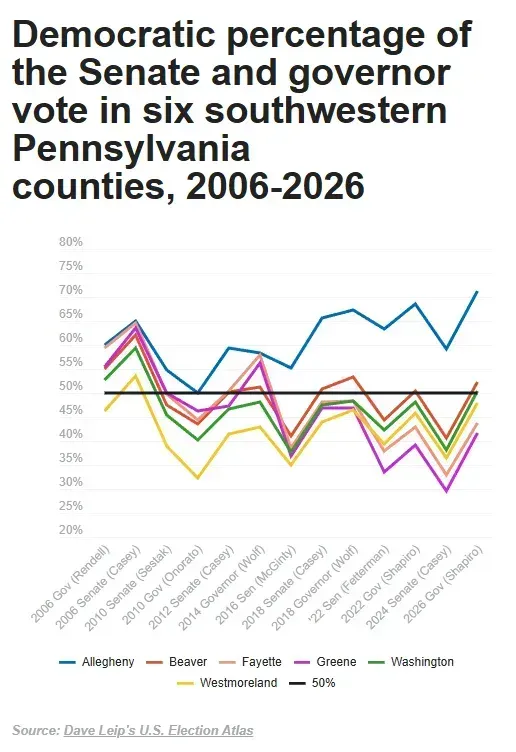
Over the full arc of these nine election cycles, the region’s voting patterns have moved away from the Democrats, with the exception of Pittsburgh-based Allegheny County, which has, if anything, become even bluer. Such developments have tracked the parallel paths of the two parties — the Democratic Party has become predominantly urban and suburban with a strong appeal to college-educated voters, while the Republican Party has become increasingly rural and attractive to blue-collar voters, who predominate in all but Allegheny County.
But if the 2024 election produced a strong Republican showing in the region, driven by Donald Trump’s quest for a second term, a backlash to Trump’s tenure offered a jolt of adrenaline for Democrats in 2026.
One pattern that’s been obvious during my previous visits to the region in the Trump era is the differential Republican turnout when Trump’s name is on the ballot compared to when he’s not.
In each of the region’s six counties, the number of votes cast for Republican gubernatorial nominee Stacy Garrity fell compared to those cast for Trump in 2024 — and the decline was even more dramatic than the falloff the GOP saw in the 2018 and 2022 midterms.
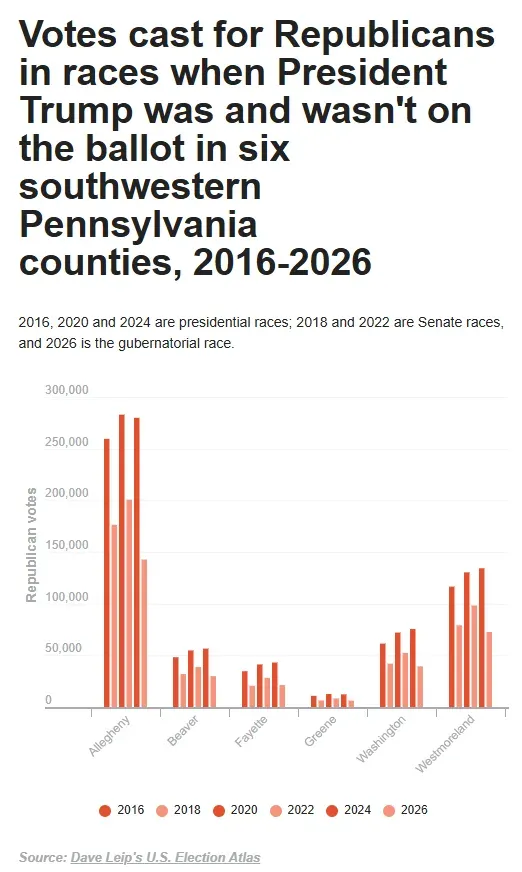
This data indicates that many voters in the region are strong Trump supporters and will pull the lever down-ballot for other Republicans when they vote for him in a presidential year — but a notable sliver of these voters won’t come out to vote at all in a midterm election, robbing down-ballot Republicans of support.
“The demographic realignment of the parties has shifted higher-propensity voters to the Democrats,” said Mike DeVanney, a founding partner at the Republican consulting firm ColdSpark.
Democrats, for their part, continued their own Trump-era patterns: Steady performance in the region, regardless of whether the election was occurring in a presidential or a midterm year.
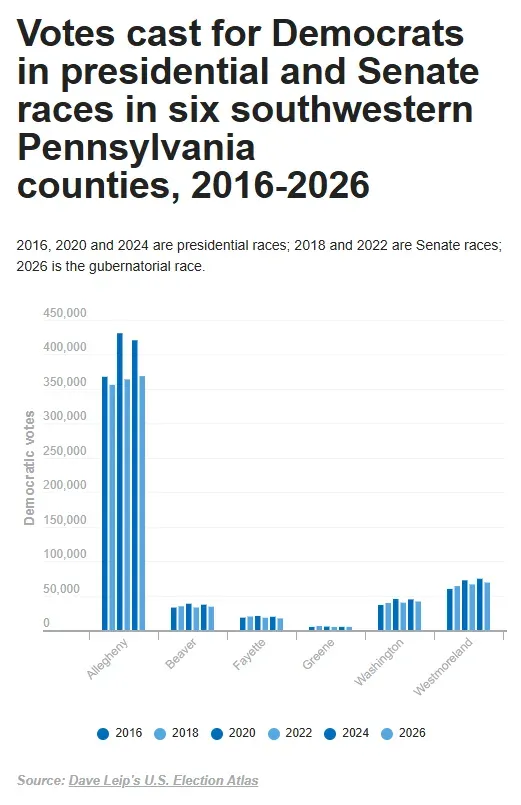
Even in Allegheny County, which saw the biggest Democratic vote decline among the six counties, the vote level for Shapiro was 12 percent lower than what presidential nominee Kamala Harris took in 2024. That was a far smaller drop than what Garrity experienced in the county: Republican votes fell by 49 percent below Trump’s 2024 level.
“Democrats had every reason to come out, whether they cared about Immigration and Customs Enforcement, whether they cared about tariffs, whether they cared about gasoline prices, whether they cared about the economy, whether they cared cared about Trump’s demeanor and his personality,” said Jon Delano, a longtime political analyst with KDKA-TV in Pittsburgh. “There was a reason for every single Democrat to come out and vote against Republicans.”
Analysts here said Southwestern Pennsylvania wasn’t a focus of political attention this year. It certainly wasn’t like 2016, a 2020, or a 2024, when Pennsylvania was a key presidential battleground state. Nor was it like 2022, when Democrat John Fetterman and Republican Mehmet Oz faced off in a hotly contested Senate race.
This year, Shapiro had always been considered heavily favored to secure a second term. He ended up winning, 61%-38% — an even wider margin than his 2022 victory over Republican Doug Mastriano. In 2026, Pennsylvania also had four closely watched U.S. House races this year, but they were all far from the state’s Southwest in the eastern part of the state.
Shapiro’s strength as a candidate, combined with the national Democratic wave, enabled him to gain ground in Southwest Pennsylvania, despite his lack of historical connections to the region.
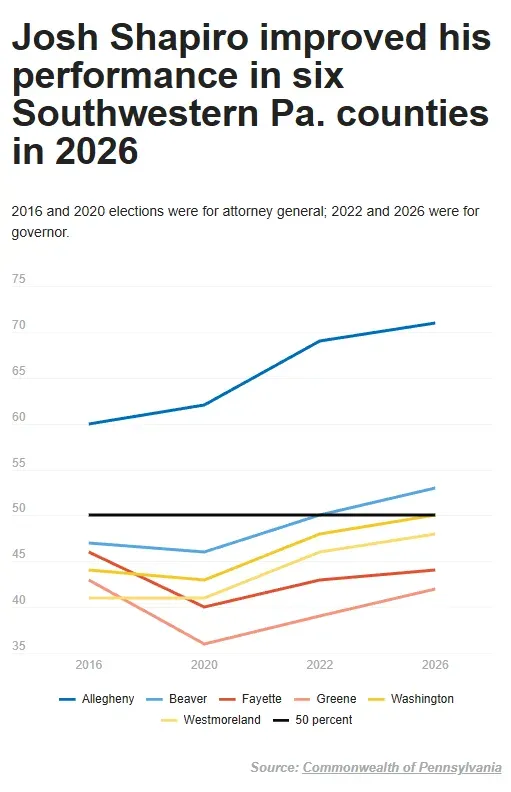
Compared to his campaigns for attorney general in 2016 and 2020 and his first gubernatorial run in 2022, Shapiro scored personal highs in vote share in Allegheny (Pittsburgh), Beaver (Aliquippa), Washington (Washington) and Westmoreland (Greensburg). He achieved his best share since 2016 in Fayette (Uniontown) and Greene (Waynesburg).
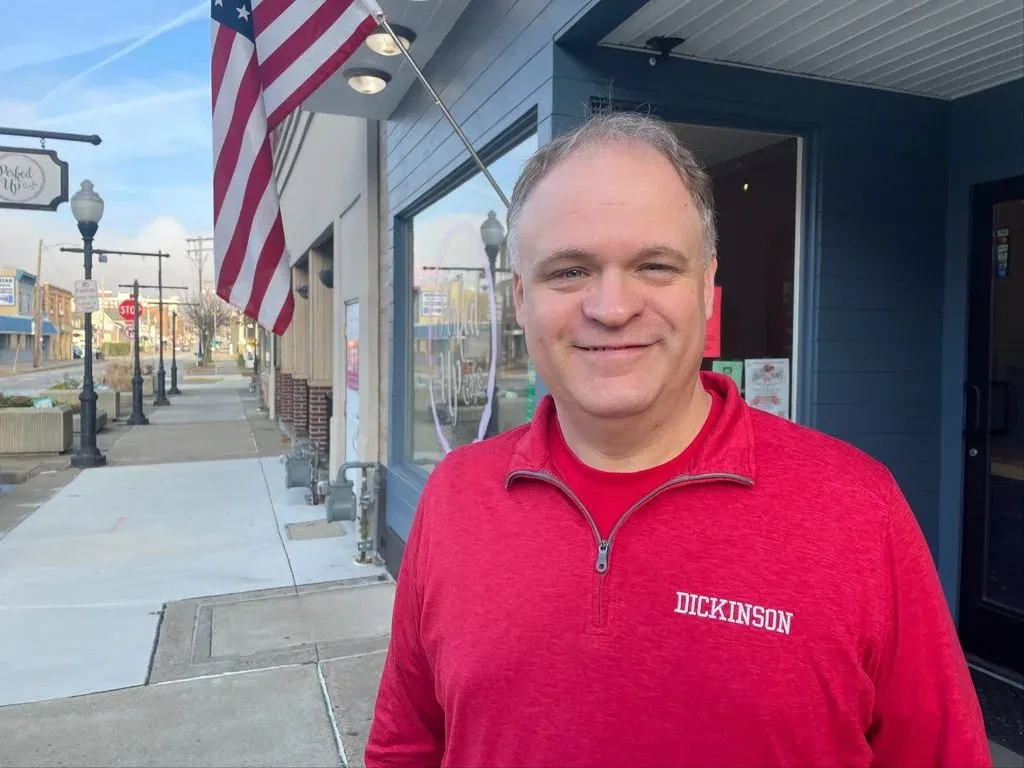
Democratic strategist Mike Butler. (Louis Jacobson / PoliticsPA)
“I think he’s the huge winner out of this,” Butler said. “He helped win the state Senate for the first time since 1994, helped pick up four congressional seats, and won by a wide margin — I mean, his electability, popularity, and confidence, all that came shining through.”
In addition to his expected win in Allegheny, Shapiro also won Washington County for the first time in 2026 and won Beaver County for the second time out of his four runs. In Westmoreland County, Shapiro fell short of Garrity by 3 points, down from Mastriano’s 6-point edge four years earlier.
“Shapiro had a massive fundraising advantage and a once-in-a-generation electoral environment,” DeVanney said.
Despite hailing from the Philadelphia area, Shapiro has won over voters in the region, said Kate Garfinkel, chair of the Allegheny County Democratic Committee.
“He has made a really strong case for himself as the governor who gets stuff done,” Garfinkel said.
The results of the region’s congressional races were less dramatic, but they were still illustrative of a Democratic wave.
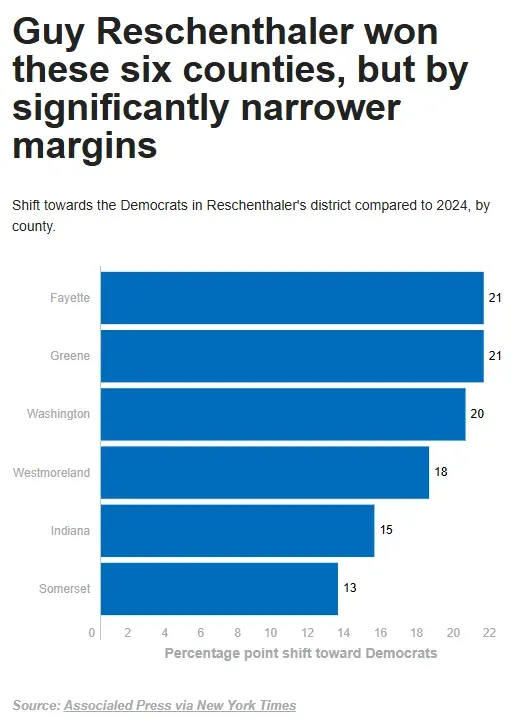
Reschenthaler did manage to win a fifth term, but his winning percentage dropped from 67 percent to 57 percent. The county-by-county breakdown was even more striking, Delano said.
Each of the district’s six counties voted more Democratic in 2026 by double digits, including 21-point shifts in Fayette and Greene counties, a 20-point shift in Washington County and an 18-point shift in Westmoreland County.
In another congressional district in the region, Deluzio, a Democrat, saw his own improvement. This district was once considered politically competitive, but no longer — at least while Deluzio is the incumbent.
In 2022, Deluzio took 54 percent of the vote. This year, he won 63 percent, with a 20-point Democratic shift in the Allegheny County portions of the district and a 19-point shift in the Beaver County portions.
Deluzio’s strong victory in 2026 will only amplify his widely discussed potential as a Senate candidate in 2028.
“He can walk into a more centrist Democratic room and be compelling, and he can walk into a more progressive Democratic room and be compelling,” Butler said.
A similar blue shift occurred further north in the congressional district held since 2010 by Republican Mike Kelly, Delano said. In a district that includes both swingy Erie County and several solidly red counties, Kelly took 54 percent in 2026, which was down from 64 percent in 2024. Each of the district’s six counties shifted their votes by between 10 and 16 points.
In House races, “clearly western Pennsylvania was not targeted by the Democratic Party,” Delano said. “If they had had unlimited, Elon Musk-type resources, then perhaps they could have targeted more seats out here. Was not doing so a mistake? Well, they won all four for four back east, so you can’t argue against the strategy they used.”
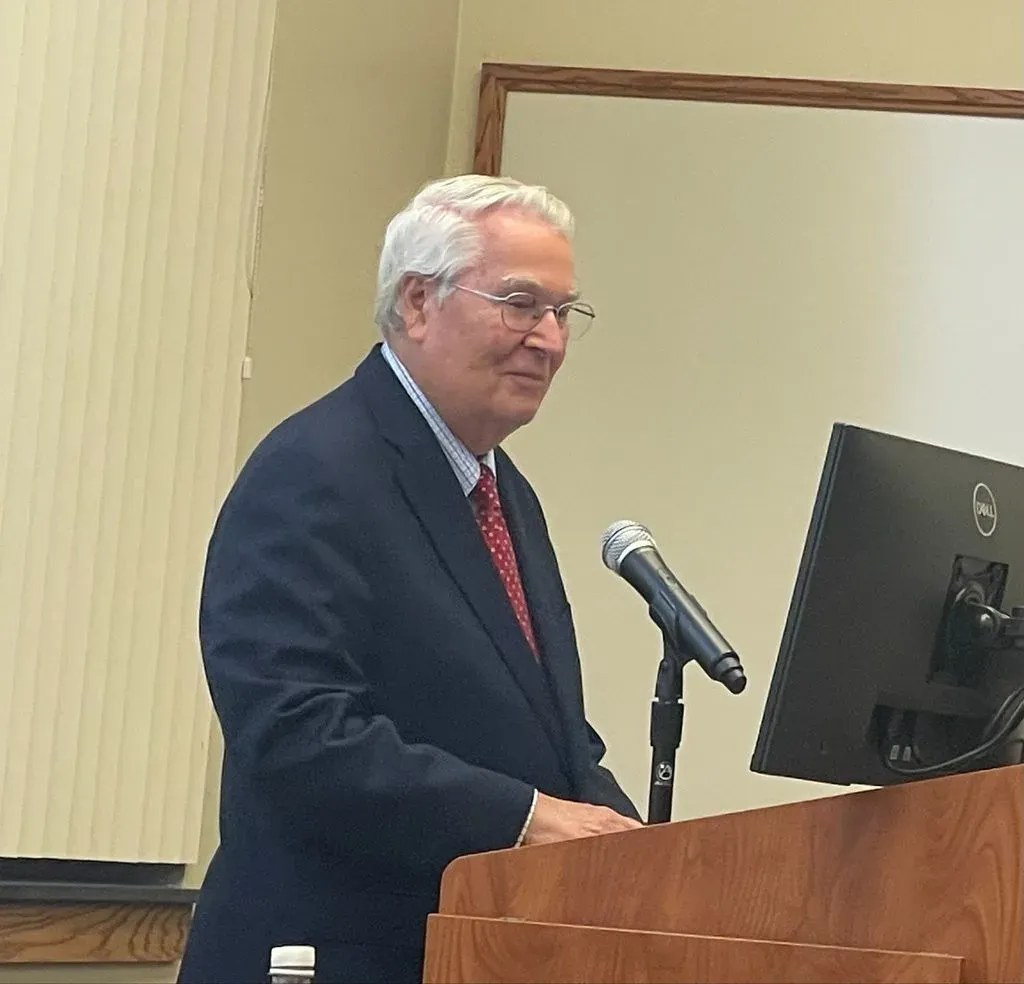
Jon Delano, longtime KDKA-TV political analyst (Louis Jacobson / PoliticsPA)
Southwestern Pennsylvania also wasn’t a focus of attention in state legislative races. Only one seat in the region ended up flipping — a state House seat in Allegheny County held by Republican Valerie Gaydos. She lost her seat, which represents Sewickley and Moon Township, to Democrat Hadley Haas by 6 points.
Garfinkel said that during Hawes’ previous run in 2024, campaign volunteers found a cool reception from voters. “This time around was a whole different world,” she said. “People were very receptive, wanting to talk.”

Kate Garfinkel, chair of the Allegheny County Democratic Committee (Louis Jacobson / PoliticsPA)
Still, some historical context is required: The Democrats’ ability to win in Southwestern Pennsylvania will remain an uphill challenge, especially after the blue environment of 2026 fades.
“These things are cyclical,” DeVanney said. “I believe that in the ashes of defeat are the embers of opportunity. We’re not going to see this type of enthusiasm from Democrats and this type of lower intensity among Republicans in 2028.”


