

Apple has announced a new 14-inch MacBook Pro powered by M6. This announcement covers the standard-chip model; it does not introduce M6 Pro or M6 Max versions. Preorders begin October 28, with availability from November 6.
The biggest changes center on the processor. M6 moves to a 2-nanometer manufacturing process and increases both CPU and GPU core counts from 10 to 12. It also introduces a dual 16-core Neural Engine and higher maximum memory bandwidth.
Wireless connectivity supplies the other major upgrade: Wi-Fi 7 and Bluetooth 6 replace the M5 model’s Wi-Fi 6E and Bluetooth 5.3. Apple claims graphics performance improves by up to 30 percent over M5.
| Feature | New 14-inch M6 | Previous 14-inch M5 |
|---|---|---|
| Manufacturing process | 2nm | Third-generation 3nm |
| CPU cores | 12 | 10 |
| CPU architecture | New complex with super, performance, and efficiency cores | Earlier CPU design |
| GPU cores | 12 | 10 |
| Graphics performance | Up to 30% faster, Apple claims | Comparison baseline |
| Neural Engine | Dual 16-core | 16-core |
| GPU Neural Accelerators | Retained across the larger GPU | Present |
| Maximum memory bandwidth | Up to 170GB/s | 153GB/s |
| Wi-Fi | Wi-Fi 7 | Wi-Fi 6E |
| Bluetooth | 6 | 5.3 |
For more on the redesigned models possibly arriving tomorrow, see our touchscreen MacBook Pro guide.
Preorders open Wednesday, October 28, 2026, through Apple’s online store and the Apple Store app.
Deliveries and sales through Apple Stores and Apple Authorized Resellers begin Friday, November 6, across 35 countries and regions.
John Brandon
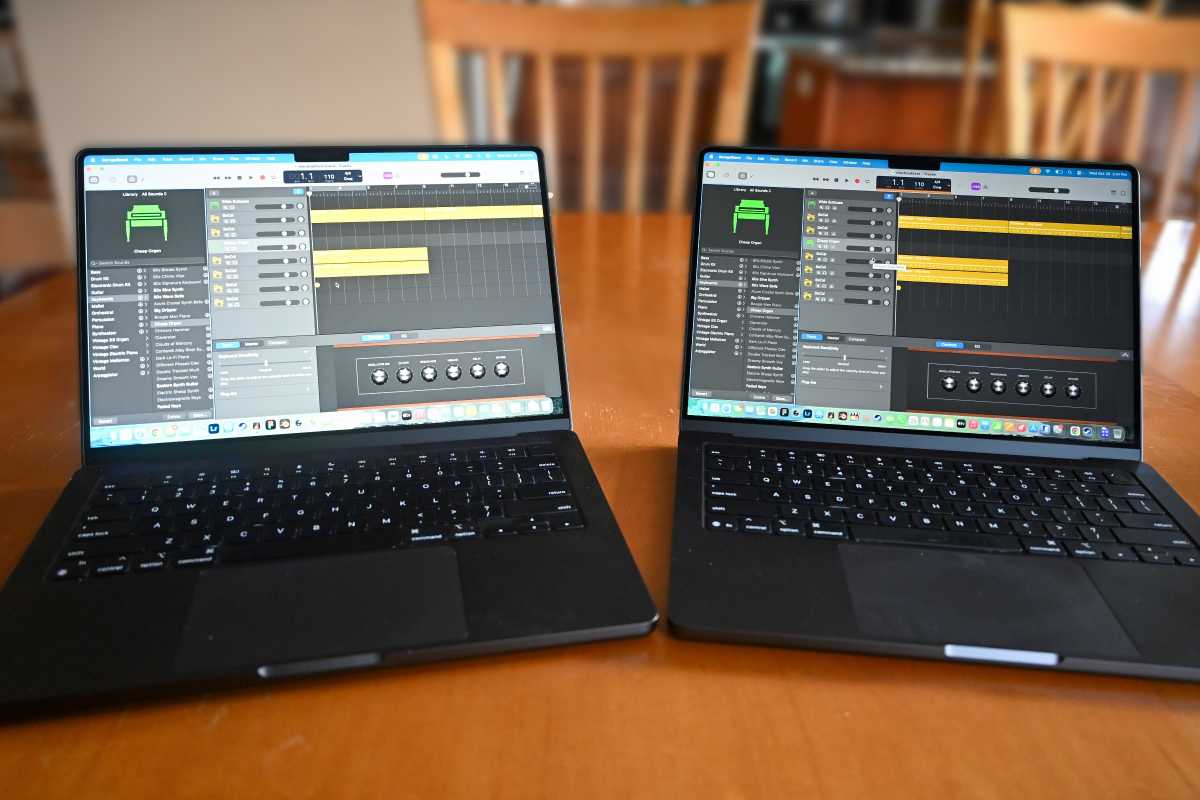
As expected, the new model continues the familiar aluminum design in Space Black and Silver. A more ambitious redesign is anticipated for the rumored touchscreen MacBook expected to launch tomorrow.
The M6 MacBook Pro retains the same dimensions and weight as its M5 predecessor. It measures 12.31 inches wide, 8.71 inches deep, and 0.61 inch thick (31.26 × 22.12 × 1.55cm), and weighs 3.4 pounds (1.55kg).
As with the predecessor, its controls include a backlit Magic Keyboard, full-height function keys, Touch ID, and a Force Touch trackpad.
Foundry
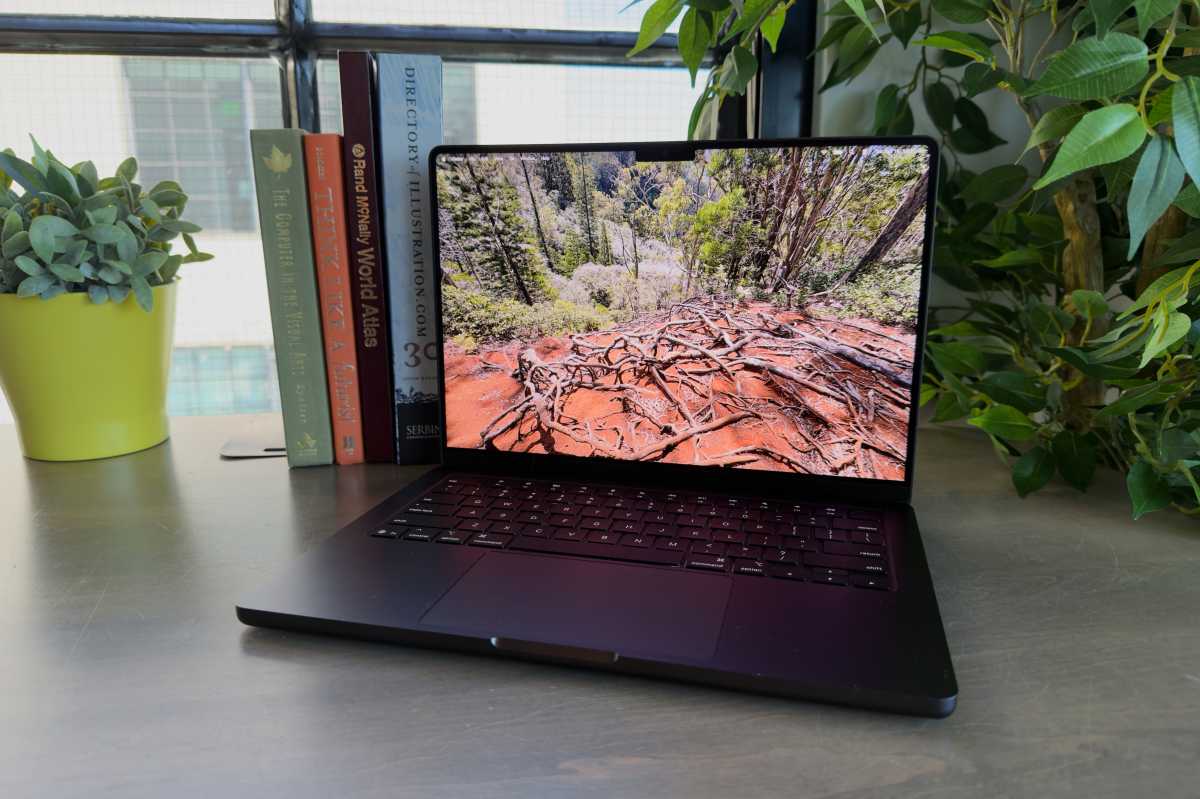
Apple has not announced a screen upgrade in this release. The M6 MacBook Pro continues to feature a Liquid Retina XDR display with an optional nano-texture finish and the same display specifications.
The M6 uses a 2nm manufacturing process, increasing transistor density, and features a 12-core CPU comprising two super cores, four performance cores, and six efficiency cores. That’s up from the M5’s 10-core CPU. Apple’s Mac mini M6 announcement claimed up to 20 percent faster multithreaded performance than M5, although that testing used a Mac mini. Read more about the M6 in our M6 deep dive.
Graphics also get a boost, with a 12-core GPU replacing the M5’s 10-core version. Neural Accelerators and hardware-accelerated ray tracing return, while memory bandwidth increases from 153GB/s to up to 170GB/s, allowing data to move more quickly between the chip and unified memory.
The M6 introduces a dual 16-core Neural Engine, compared with the M5’s single 16-core engine. For this laptop, Apple reports up to 1.9 times faster Neural Engine performance and 25 percent faster on-device AI workloads versus M5. These are separate measures of performance, with the benefits depending on the task and how an app uses the chip.
The Media Engine retains the M5’s listed capabilities, including hardware acceleration for H.264, HEVC, ProRes, and ProRes RAW, alongside AV1 decoding. Dedicated video encoding and decoding hardware helps handle demanding media tasks efficiently, but Apple’s comparison sheet lists no new codec support for M6.
| Specs | M6 | M5 |
|---|---|---|
| CPU | 12 cores: 2 super, 4 performance, 6 efficiency | 10 cores: 4 super, 6 efficiency |
| GPU | 12 cores | 10 cores |
| Neural Engine | Dual 16-core | Single 16-core |
| Memory bandwidth | Up to 170GB/s | 153GB/s |
The M6 MacBook Pro starts with 16GB of unified memory, with 24GB and 32GB configurations also available – the same capacities offered with M5. However, memory bandwidth increases from 153GB/s to up to 170GB/s, helping the chip access data more quickly.
Additional unified memory gives applications and graphics workloads more room to operate simultaneously. For local AI, capacity affects which models fit in memory, while bandwidth affects how quickly data can move.
Buying advice: Choose 16GB for everyday productivity; consider 24GB for heavier multitasking and creative work, or 32GB for memory-intensive projects and local AI experimentation.
Wireless connectivity improves with Wi-Fi 7 (802.11be) and Bluetooth 6, replacing the M5 model’s Wi-Fi 6E and Bluetooth 5.3. Wi-Fi 7 availability varies by country.
The physical connections remain unchanged, including three Thunderbolt 4 (USB-C) ports, HDMI, an SDXC card slot, and a 3.5mm headphone jack with support for high-impedance headphones.
Apple rates the M6 MacBook Pro for up to 24 hours of video streaming or 16 hours of wireless web browsing, matching the M5 model. These are Apple’s test figures; we’ll be running our own independent battery tests to establish whether M6 delivers better endurance during everyday work or more demanding tasks.
In the U.S. a 70W USB-C power adapter ships with both models, this is an extra expense in the U.K. and Europe (as was the case for the M5 model). Fast charging requires a 96W or higher USB Power Delivery source, so buyers who want that capability should check their adapter’s output. The listed 70W adapter does not meet Apple’s fast-charging requirement.
| Battery/charging specification | Both models |
|---|---|
| Wireless web browsing | Up to 16 hours |
| Video streaming | Up to 24 hours |
| Battery capacity | 72.4Wh lithium-polymer |
| Power adapter listed | 70W USB-C |
| Fast charging | Requires a 96W or higher USB PD power source |
The U.S. and U.K. starting price is $1,999/£1,999, or $1,899/£1,899 for eligible education buyers. That matches the outgoing model’s current U.S. starting price, rather than its original launch price.
| Model and pricing point | U.S. starting price | U.K. starting price |
|---|---|---|
| M5 at October 2025 launch | $1,599 | £1,599 |
| Outgoing M5, current listing | $1,999 | £1,999 |
| New M6 | $1,999 | £1,999 |
| M6 vs. current M5 | No increase | Await confirmation |
| M6 vs. original M5 U.S. launch | $400 more | $400 more |
Buy if: You need a replacement now and the standard MacBook Pro meets your workload. Buyers moving from older machines are more likely to notice the improvement than recent M5 owners.
Don’t buy if: Your M5 already handles your work comfortably. Wait for independent benchmarks before paying to replace it, especially if one particular application drives your decision.
Which configuration? Prioritize memory around the projects you actually run. For demanding graphics, large datasets, or professional video work, compare the full specifications and benchmarks of Pro and Max models rather than choosing solely by the newer “M6” name.
Wait if: An OLED touchscreen or redesigned chassis would materially affect your purchase. These may arrive tomorrow, and for a more powerful chip, reports indicate the M7 Pro/Max is expected in 2027, rather than an M5 Pro and M5 Max now.
Of the five generations of MacBook Pro, five have been released in the October/November timeframe. The list below also demonstrates that Apple doesn’t always introduce the standard, Pro and Max versions of a chip generation together.


